Table of Contents
Table of Contents
I’m Becky Masson, a home cook in Austin, Texas, and I share my kitchen with my curious cat, Miso, who believes every grocery bag contains something exclusively for him. I learned to cook in my grandmother’s warm, scent-filled kitchen, then leaned on it hard during university when life felt loud and my brain needed something soothing and practical to focus on. Now I’m that person taking classes, chasing seasonal produce at the store, and experimenting with nostalgic flavors. Some attempts flop (we don’t talk about the “burnt lentil loaf incident”), but when a simple swap makes a meal taste better and feel better afterward, that’s my definition of success.
So if you’re here because you typed New Food Pyramid into Google and got a swirl of charts, “new rules,” and hot takes, you’re not alone. Let’s sort it out together in a way that actually helps you shop, cook, and eat with less stress.
The New Food Pyramid 2026 is the U.S. government’s inverted food pyramid accompanying the Dietary Guidelines for Americans, 2025–2030. This guide explains what changed and how the official model differs from other healthy-eating pyramids.
This article is part of our Clean Eating Guide, where we break down nutrition fundamentals, diet plans, and structured reviews.
Note: This content is based on personal research and general nutrition information, and covers the Dietary Guidelines for Americans, 2025–2030, alongside practical cooking suggestions. It is intended for educational and lifestyle purposes only and does not constitute medical or dietary advice. Nutrition needs vary by individual, health status, and country-specific guidelines. Always consult a doctor or registered dietitian before making significant dietary changes, especially if you have diabetes, cardiovascular disease, or another condition requiring tailored nutrition guidance.
What the “New Food Pyramid 2026” actually is (and what it’s not)
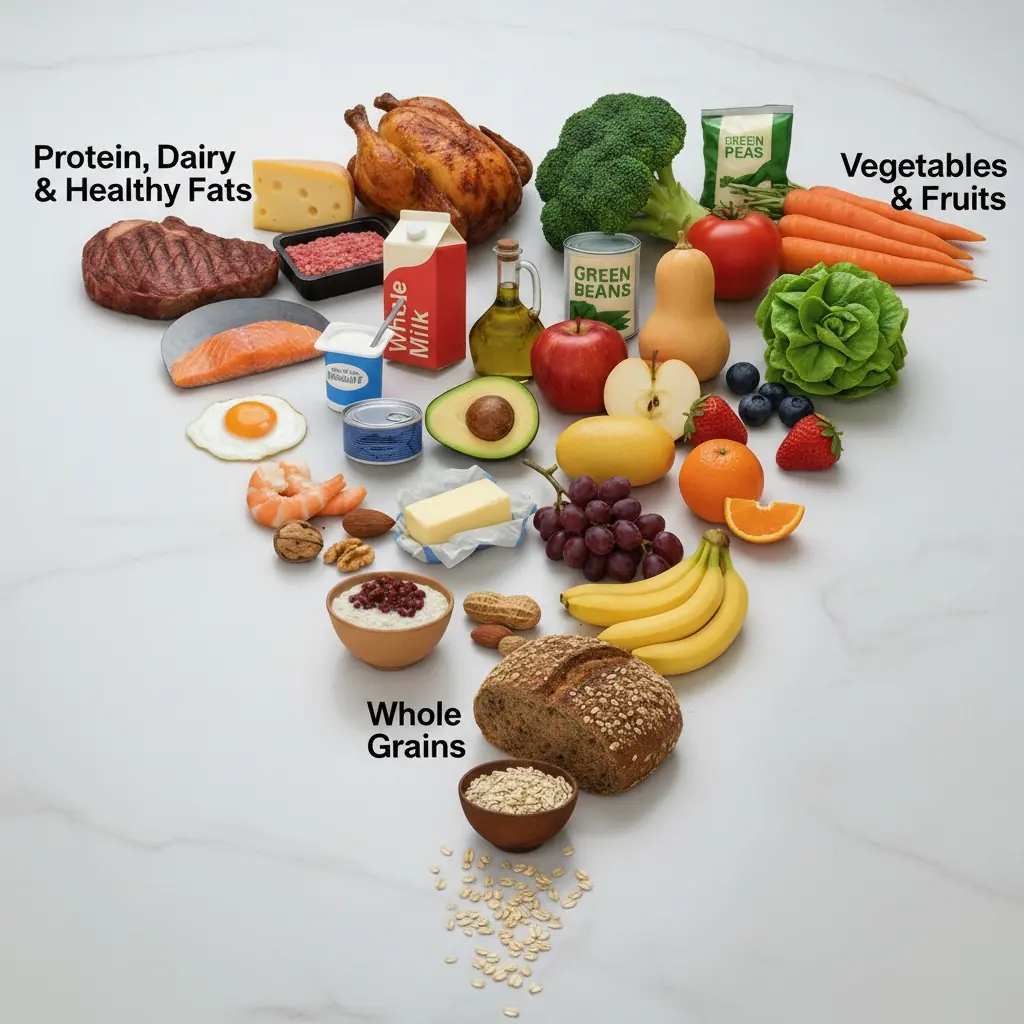
The New Food Pyramid 2026 is the official U.S. inverted pyramid accompanying the Dietary Guidelines for Americans, 2025–2030. Its broad upper section features protein, dairy, healthy fats, vegetables, and fruits, while whole grains occupy the narrower bottom section.
- Updated national dietary guidance (the kind governments and public health agencies publish and refresh as evidence changes).
- Modern “healthy eating pyramid” visuals used in schools, clinics, wellness apps, and health systems to explain that guidance quickly.
Here’s what it’s not: one single, universal pyramid that every country adopted on January 1st, 2026. Different countries publish different versions of dietary guidance, and some don’t use a pyramid at all (plates, circles, and other models are common). But the “2026” conversation keeps popping up because nutrition science and the modern food environment have shifted in big ways, especially around:
- Ultra-processed foods (a bigger deal than we used to admit)
- Fiber and gut health (less “nice to have,” more “non-negotiable”)
- Protein quality (not just “get enough,” but “from what?”)
- Metabolic health (blood sugar, insulin resistance, triglycerides, fatty liver)
In this article, the New Food Pyramid refers to the official 2026 U.S. model; other healthy-eating pyramids are separate frameworks. We’ll compare the classic food pyramid chart vs newer pyramid-style frameworks and talk about what changed in real-life terms.
Quick snapshot of the biggest shifts you’ll notice:
- Quality > quantity (especially for carbs and fats)
- Greater emphasis on protein foods, dairy, vegetables, and fruits
- Less ultra-processed “everyday food”
- Whole grains remain included, while refined carbohydrates are discouraged
- Healthy fats are included alongside protein and dairy
If you’ve felt confused reading about the New Food Pyramid, it’s usually because people mix old pyramid rules with newer evidence and call it an “update.” Let’s untangle it.
Understanding calorie balance is essential for clean eating. You can also read our guide on what a calorie deficit is to go deeper.
A quick rewind: the classic Food Guide Pyramid (why it got criticized)

The original “food groups pyramid” concept was designed to be simple: the base was what you should eat most of, and the tiny top was what you should eat least of.
Classic pyramid structure, in broad strokes:
- Base: grains (often interpreted as bread, cereal, pasta, rice)
- Next: fruits and vegetables
- Next: protein foods and dairy
- Top: fats, oils, sweets (use sparingly)
What worked:
- It gave a clear visual hierarchy.
- It made nutrition education easier for kids (and busy adults).
- It offered a “big picture” instead of a complicated nutrition lecture.
But the criticisms piled up over time, especially as our food supply changed:
- Too carb-heavy without enough clarity about whole vs refined grains. A bagel and a bowl of steel-cut oats did not get the same reaction in your body, but the pyramid didn’t always make that obvious.
- Fats were lumped together. Olive oil and trans-fatty shortening did not deserve the same caution label.
- Added sugar was underplayed. “Sweets” were up top, sure, but sugar snuck into yogurt, cereal, sauces, and “healthy” snack bars.
- Ultra-processed foods weren’t addressed. The pyramid was built for a world where you cooked more and packaged food was less engineered.
- Portions were confusing. “Servings” weren’t intuitive, and people got lost in counting.
By the time we reach the ideas behind the New Food Pyramid, updates weren’t just “nice.” They were inevitable.
The New Food Pyramid 2026 in one glance: the new priorities
The official New Food Pyramid 2026 uses an inverted shape. Here is how its main food groups are arranged:
| Position in the official pyramid | Food groups |
|---|---|
| Broad upper section | Protein, dairy, and healthy fats |
| Broad upper section, alongside protein foods | Vegetables and fruits |
| Narrower bottom section | Whole grains |
The accompanying guidance also recommends water or unsweetened beverages and avoiding highly processed foods.
Beyond the official graphic, these practical food-quality habits can help when planning meals:
- Whole grains over refined grains
- Unsaturated fats over saturated and trans fats
- Lean/plant proteins more often
- Fewer sugary drinks
- Fewer ultra-processed “daily staples”
Some other healthy-eating pyramids add a lifestyle layer, although this is not a separate layer in the official 2026 U.S. graphic:
- Movement
- Sleep
- Stress management
- Social connection
Honestly, I love this part because it matches real life. I can cook the most gorgeous salmon bowl in Austin, but if I slept four hours and drank two sweet coffees, my appetite cues get weird and my patience disappears. (Miso still expects dinner on time, of course.)
Unlike clean eating, fasting focuses on meal timing and than food quality.
Day-to-day translation: what moves up and down
- Practical choices to include more often: non-starchy veg, beans/lentils, whole grains, nuts/seeds, fish
- Practical choices to limit: refined grains, processed meats, sugary drinks, packaged snacks marketed as “healthy”
These everyday swaps can help translate nutrition guidance into meals.
What changed in 2026 (the practical updates you’ll feel at the grocery store)
This is where the New Food Pyramid actually becomes useful, because it changes what lands in your cart.
Carbs: from “more grains” to “smarter carbs”
The newer focus is:
- Whole grains (oats, brown rice, quinoa, whole wheat, barley)
- Legumes (beans, lentils, chickpeas)
- Fiber targets (because fiber is one of the biggest “missing” nutrients)
And the downshift:
- Refined grains (white bread, many crackers, pastries, most boxed baked goods)
- “Whole grain” products that are mostly refined flour with a health halo
Protein: more emphasis on quality and variety
The 2026 U.S. guidance emphasizes protein from both animal and plant sources, including:
- Fish and seafood (often a regular feature)
- Beans, lentils, tofu, tempeh
- Eggs and poultry (common options)
- Red meat is also included in the official guidance; highly processed meats should be limited
Sodium: practical reduction strategies
Not “never eat salt,” but “stop getting ambushed by it.” Big sources are:
- Sauces and packets (seasoning blends, ramen packets, bottled dressings)
- Restaurant meals
- Packaged snacks
Grocery-store habits that help:
- Compare labels for sodium per serving
- Choose no-salt-added canned goods when possible
- Use acids and herbs at home (lemon, vinegar, garlic, chili flakes) to make lower-sodium food taste alive
Ultra-processed foods: stronger language, clearer identification
A huge shift behind the New Food Pyramid is that ultra-processed foods are no longer treated like a neutral convenience. Possible clues -not a definitive test- include:
- Long ingredient lists with additives you wouldn’t cook with
- “Flavorings,” emulsifiers, gums, colorants, sweeteners stacked together
- Products engineered to be hyper-palatable (the “can’t stop eating it” effect)
This shift also aligns with the need for adopting healthier eating habits as suggested by various healthy eating tips.
Portion clarity: make the pyramid actionable
Alongside the official serving recommendations, practical portion tools include:
- Plate method
- Hand-size portions (palm of protein, fist of carbs, thumb of fat)
- “Half the plate veggies” as a default anchor
The updated food pyramid chart: the food groups (and what counts in each)
If you’re a visual person (I am), here’s a practical food-group reference to use alongside the official 2026 pyramid. The categories below organize shopping examples; they are not separate layers in the official graphic.
| Food group or category | Food examples | What to watch |
|---|---|---|
| Vegetables + fruits | Leafy greens, broccoli, peppers, mushrooms, cucumbers, tomatoes; whole fruit such as berries, apples, oranges, and bananas. Fresh, frozen, and canned options can fit. | Check canned fruit for added sugar or heavy syrup and vegetable soups for sodium. Fruit snacks, fruit juice cocktails, and “veggie chips” are not equivalent to whole produce. |
| Whole grains + legumes | Whole grains: oats, brown rice, quinoa, barley, farro, whole wheat bread and pasta. Legumes: beans, lentils, chickpeas, peas, hummus, and edamame. | Check bread, pasta, and hummus ingredients. Whole grains occupy the narrower bottom section of the official pyramid; legumes also contribute to the protein group. |
| Protein foods | Fish, seafood, poultry, eggs, tofu, tempeh, beans, lentils, Greek yogurt, and cottage cheese. Nuts and seeds contribute protein and fats. The official model also includes red meat. | Limit highly processed meats such as hot dogs and deli meats. Avoid making breaded, fried proteins your default. |
| Dairy or fortified alternatives | Milk, plain yogurt, kefir, and cheese. Fortified soy milk is a nutritionally comparable alternative to dairy milk. | Compare protein, calcium, vitamin D, and added sugar in alternatives. Sweetened plant milks and flavored yogurts can contain substantial added sugar. |
| Healthy fats | Olive oil, avocado oil, nuts, seeds, tahini, avocado, and olives. | Avoid trans fats and consider portions. The dietary guidelines retain a saturated-fat limit of less than 10% of daily calories. |
| Foods to limit | Sweets, desserts, refined snacks such as chips and pastries, and fried foods. | This is a practical category, not a separate top layer in the official 2026 inverted pyramid. |
Hydration (fits alongside the pyramid)
Default
- Water, sparkling water
- Unsweetened tea/coffee
Limit
- Sugary drinks (soda, sweet tea, energy drinks)
- “Coffee drinks” that are basically milkshakes
Go-Grow-Glow foods pyramid: where it still fits (and where it needs an update)
If you’re a parent, teacher, or just someone trying to explain food simply, Go-Grow-Glow is still genuinely helpful.
- Go foods = energy foods
- Grow foods = body-building foods
- Glow foods = protective foods (vitamins/minerals)
But it needs a 2026-style refresh so “Go” doesn’t become code for sugar bombs.
Go-Grow-Glow is a separate nutrition education tool, not the official 2026 U.S. pyramid. Its categories describe food functions and can overlap.
Go (energy)
Maps best to:
- Whole grains
- Starchy vegetables (potatoes, corn, winter squash)
- Legumes
- Some fats (because fats are also energy)
Update: “Go” should not mean refined carbs and sugary cereal as a daily thing. For the official 2026 recommendations, see the Dietary Guidelines for Americans, 2025–2030.
Grow (body-building)
Maps best to:
- Protein foods (fish, poultry, eggs, beans, tofu)
- Dairy or fortified alternatives
Update: emphasize lean and plant proteins more often, and limit processed meats.
Glow (protective)
Maps best to:
- Vegetables and fruits, especially variety and color
Update: add modern guidance: aim for fiber, limit added sugar, and keep ultra-processed foods from taking over snack time.
If you like the simplicity of Go-Grow-Glow, you can absolutely use it with the New Food Pyramid as the “quality filter.”
Some people prefer structured approaches like low-carb or keto diets, which follow different macronutrient principles.
Healthy eating pyramid vs “diet pyramids”: Mediterranean, keto, and weight loss versions
People search multiple pyramids because they want a clear framework that matches their goal:
- Heart health
- Weight loss
- Blood sugar control
- Athletic performance
- Convenience and budget
The New Food Pyramid 2026 presents general U.S. dietary guidance. Mediterranean, keto, and weight-loss pyramids are separate frameworks with different origins and purposes; they are not official variations of the 2026 model.
The best pyramid is the one you can follow consistently, that supports your health markers, and that doesn’t make you dread dinner.
Mediterranean diet food pyramid: how it differs from the 2026 model
If you’ve ever asked, “Okay, but what should I cook this week?” the Mediterranean pyramid is basically a friendly answer.
Mediterranean pyramid layers (simplified):
- Plants as the foundation (vegetables, fruit, legumes, whole grains)
- Olive oil as the primary fat
- Nuts and seeds often
- Fish/seafood regularly
- Dairy moderate (often yogurt/cheese)
- Poultry/eggs in moderation
- Red meat occasional
- Sweets rare
Unlike the inverted 2026 U.S. pyramid, the Mediterranean pyramid places plant foods at its broad base, emphasizes olive oil, and includes red meat less frequently. Both models encourage vegetables, fruits, whole grains, and fewer highly processed foods.
For the full food-group breakdown, serving guidance, and practical meal examples, see our Mediterranean Diet Pyramid guide.
Keto food pyramid (how it differs from the 2026 pyramid and who should be cautious)
A typical keto pyramid looks like:
- Base: non-starchy veg + fats
- Moderate protein
- Minimal grains, fruit, legumes
Key differences vs diet trends
- Keto restricts carbs heavily.
- Keto typically sets carbohydrate and fat targets, while the official 2026 pyramid includes fruits and whole grains without prescribing ketogenic macros.
- Keto can create fiber gaps if it’s built around cheese, butter, and “keto snacks” instead of vegetables, nuts, and seeds.
How to “keto-proof” quality (if you’re doing it)
- Prioritize unsaturated fats (olive oil, avocado, nuts, seeds)
- Keep vegetables high (especially leafy greens and cruciferous veg)
- Choose fish often
- Avoid ultra-processed keto bars, keto cookies, and sweetener-heavy products as daily staples
Caution notes
Keto can be risky or complicated if you:
- Take diabetes medications (hypoglycemia risk)
- Have lipid changes (some people see LDL rise)
- Struggle with adherence (it can be socially and practically hard)
If you’ve got a medical condition, it’s worth doing keto with professional guidance. For an introduction to ketosis and how the diet works, see our Keto Diet guide.
Food pyramid for weight loss: what the 2026 changes mean for fat loss (without fad rules)
The official 2026 pyramid is general dietary guidance, not a dedicated weight-loss plan. Practical habits that can support weight management include:
- High-volume vegetables
- Adequate protein
- Higher fiber carbs (or smaller portions of carbs if needed)
- Fewer liquid calories
- Less ultra-processed snacking
Food choices alone do not guarantee weight loss; portions, overall energy intake, and individual needs also matter. For portion guidance, satiety tips, and practical examples, see our Food Pyramid for Weight Loss guide.
How to use the New Food Pyramid 2026 in real life (a 7-day implementation approach)
You don’t need a total kitchen makeover. Here’s a practical 7-day approach to applying the guidance, not an official government meal plan.
| Days | Focus | What to do | Practical examples |
|---|---|---|---|
| Days 1–2 | Audit the pantry and fridge | Identify your ultra-processed staples. Pick 1–2 replacements you’ll actually eat. | Sugary cereal → oats + fruit + nuts. Chips every night → popcorn + salsa + veggie sticks. Sweetened yogurt → plain Greek yogurt + berries + cinnamon. |
| Days 3–4 | Upgrade carbs | Switch one refined grain to a whole grain you like. Add beans or lentils twice this week. | Taco night: add black beans. Pasta night: do half pasta, half chickpeas or sautéed vegetables. |
| Days 5–6 | Upgrade proteins | Plan two easy proteins you’ll repeat. Add one fish meal. | Rotisserie chicken, tofu stir-fry, or canned salmon. A salmon salad sandwich can be an easy fish meal. |
| Day 7 | Lock in go-to breakfasts and lunches | Choose repeatable breakfasts and lunches to make daily planning easier. | Breakfast: eggs + spinach + whole grain toast. Lunch: lentil soup + side salad + fruit. |
Label-reading shortcuts (fast, not obsessive)
- Added sugars: lower is better
- Sodium: compare options, watch sauces
- Fiber: higher fiber usually signals better carb quality
- Ingredients: check what the product contains; list length alone does not determine nutritional quality
Budget tips (Austin grocery reality friendly)
- Frozen vegetables and fruit
- Canned beans and canned fish
- Store-brand oats and rice
- Bulk lentils
- Big tubs of plain yogurt
A simple “pyramid day” sample menu (easy to adapt)
Here’s a practical sample day using foods featured in the New Food Pyramid. It is an illustrative menu, not an official meal plan; portions should suit your individual needs.
| Meal | Sample foods | Food groups represented |
|---|---|---|
| Breakfast | Oatmeal cooked with milk or fortified soy milk, topped with berries and chopped walnuts. | Whole grains, fruit, protein, and healthy fats; dairy if using milk. |
| Lunch | Big salad bowl: greens + chopped veggies + chickpeas + quinoa + olive oil/lemon dressing. | Vegetables, plant protein, whole grains, and healthy fats. |
| Snack | Plain Greek yogurt with cinnamon and sliced banana, or an apple + peanut butter. | Yogurt option: dairy, protein, and fruit. Apple option: fruit, plant protein, and healthy fats. |
| Dinner | Sheet-pan salmon with roasted broccoli and sweet potato, olive oil, garlic, and lemon. | Protein, vegetables—including a starchy vegetable—and healthy fats. |
| Beverages | Water, sparkling water, unsweetened tea/coffee. | Hydration alongside meals. |
Mediterranean-leaning variation
- Add a side of lentils or white beans tossed with herbs
- Use extra virgin olive oil generously but not mindlessly
- Finish with fruit for dessert
Lower-carb (not full keto) variation
- Swap quinoa/sweet potato portion for more non-starchy veg
- Keep protein steady
- Add avocado or nuts for satisfaction
Customization levers
- Vegetarian: swap salmon for tofu or tempeh; add extra legumes
- Lactose intolerance: lactose-free dairy or fortified soy
- Cultural foods: keep your staples, just upgrade quality and portions (whole grains, more veg, less ultra-processed)
The bottom line: what to remember from the New Food Pyramid 2026
The official New Food Pyramid 2026 uses an inverted graphic, placing protein, dairy, healthy fats, vegetables, and fruits across its broad upper section, with whole grains at the narrower bottom. Alongside that model, these practical habits can help guide everyday meals:
- Prioritize minimally processed plants
- Choose better carbs (whole grains and legumes)
- Diversify protein (more fish and plant proteins, less processed meat)
- Favor unsaturated fats
- Reduce added sugar and sodium
- Limit ultra-processed foods as everyday staples
If you want the simplest action-first takeaway: pick three swaps this week.
- One carb upgrade (white bread → whole grain, or add beans)
- One protein upgrade (processed meat → fish/beans/tofu)
- One snack upgrade (packaged sweets → fruit + nuts, yogurt, popcorn)
These swaps are practical starting points; adapt them to your preferences and nutritional needs.
FAQs
Is the “New Food Pyramid 2026” an official government update?
Yes. The New Food Pyramid 2026 is an official U.S. government graphic accompanying the Dietary Guidelines for Americans, 2025–2030. It uses an inverted pyramid to present the main food groups. Other countries have their own dietary guidelines and visual models.
What is the biggest change from the classic Food Guide Pyramid?
The clearest visual change is the inverted shape. The classic 1992 pyramid placed grains at its broad base; the official 2026 model places protein, dairy, healthy fats, vegetables, and fruits across its broad upper section, with whole grains at the narrower bottom. The accompanying guidance also emphasizes nutrient-dense foods and avoiding highly processed foods. For a separate plant-focused framework, explore our Mediterranean Diet Pyramid guide.
Does the 2026 pyramid eliminate carbohydrates?
No. Carbohydrates remain a primary energy source. The official 2026 pyramid includes whole grains, vegetables, and fruits, all of which provide carbohydrates. It encourages fiber-rich whole grains and reducing highly processed refined carbohydrates and added sugars; it does not prescribe a ketogenic diet.
Where do ultra-processed foods fit?
They do not occupy a separate layer in the official 2026 pyramid; the accompanying dietary guidance recommends avoiding highly processed foods. High intake of ultra-processed foods is consistently associated with poorer metabolic and cardiovascular outcomes, which is why modern Clean Eating frameworks now explicitly address them.
Is dairy required?
The official 2026 U.S. guidance includes dairy and recommends three servings per day for a 2,000-calorie eating pattern. People who avoid dairy need suitable alternatives to meet their nutritional needs. Plain yogurt, kefir, and minimally processed dairy are preferred, while fortified soy milk is the closest plant-based nutritional equivalent.
Can this pyramid work for Vegetarian or Keto diets?
Vegetarian: Yes. The framework can be adapted for vegetarian eating patterns by including foods such as legumes, tofu, tempeh, nuts, and seeds.
Keto: Possible, but more restrictive. Since keto limits legumes and whole grains, additional planning is needed to maintain fiber and micronutrient diversity.
How does this model support weight management?
Rather than focusing only on calorie counting, the 2026 pyramid emphasizes satiety through fiber, protein, and food volume. Reducing liquid calories and hyper-palatable snacks may help lower overall energy intake, but a Calorie Deficit still depends on total intake relative to energy expenditure.
What are simple starter changes?
– Replace one refined grain with a whole grain.
– Add one additional serving of vegetables per meal.
– Replace one sugary beverage with water or unsweetened tea.